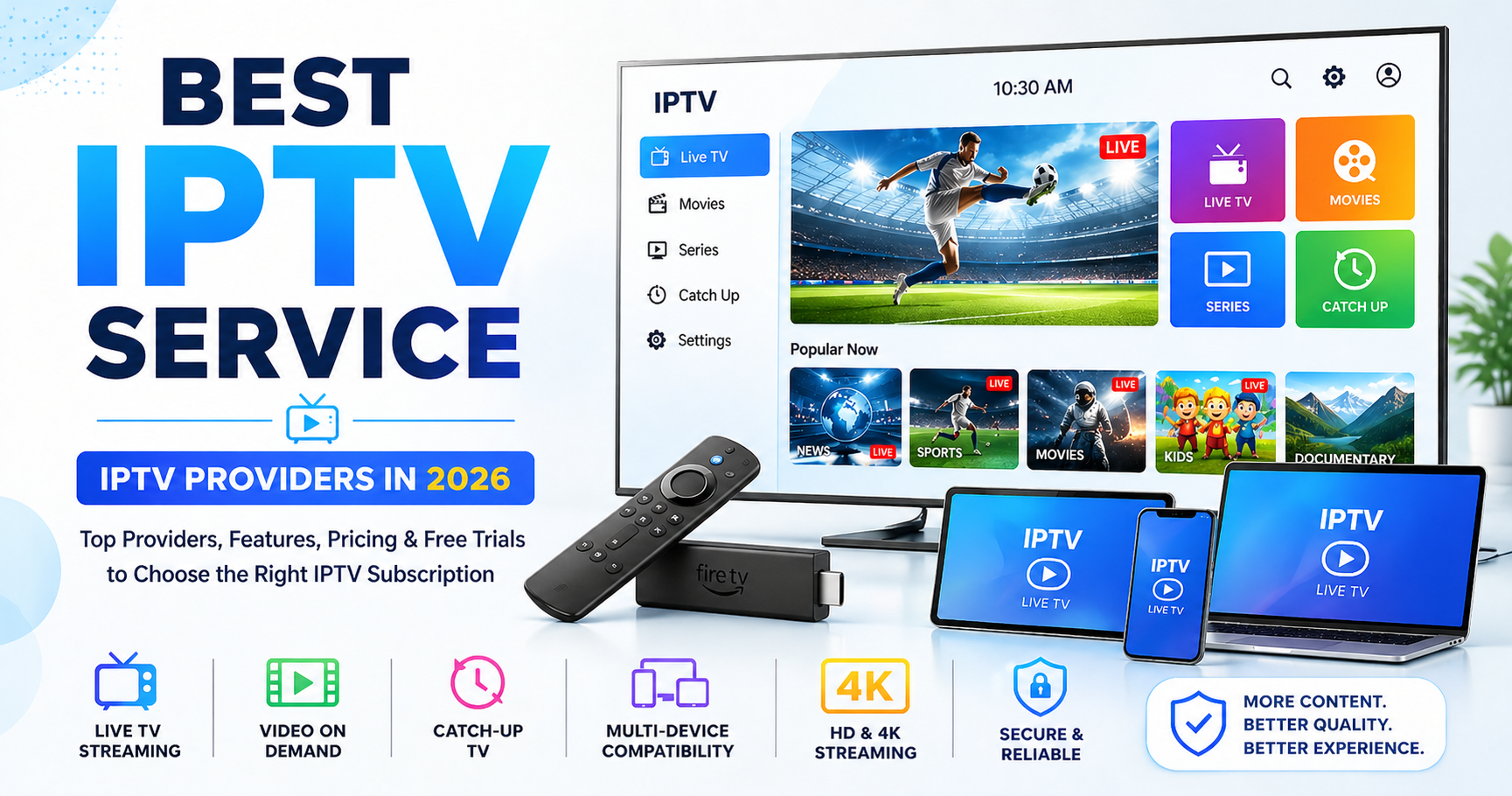
iptv service Summary
A premium IPTV service leverages a high-speed internet connection to stream live television and a massive on-demand library directly to your screen. Its primary benefit is cost efficiency, often delivering more channels and content than traditional cable at a significantly lower monthly rate.
| Optimal ForCord-cutters & international households | Key AdvantageMassive channel count & multi-device support |
- ✓ Key Strength: Up to 20,000+ live channels with global news, sports, and entertainment in one interface
- ✓ Key Strength: Streams in 4K, FHD, and HD with anti-freeze technology for minimal buffering
- ✓ Peace of Mind: 24/7 customer support and an uptime guarantee included with every plan
In This Guide
What is an IPTV Service and How Does It Work?
An IPTV service uses your broadband connection to deliver television programming through a managed or unmanaged network. Unlike standard web video streaming (OTT), IPTV providers often utilize dedicated servers and content delivery networks (CDNs) to ensure stable, high-quality streams. The architecture typically involves three key components: the provider's server, your internet connection, and an endpoint device (Smart TV, Android box, or mobile app).
The technology operates by transmitting video content as data packets over the internet protocol. When you select a channel, your device sends a request to the server via a middleware, which then routes the encoded video stream to you. The process is generally instantaneous. For the user, it means that you are no longer bound by a provider's broadcast schedule; you can access content on demand, pause live TV, and record shows using cloud DVR features.

The Three Primary Delivery Models of IPTV
Understanding the delivery model helps you choose a service that matches your internet setup and device ecosystem:
- Video on Demand (VOD): This is a digital library where you select a movie or show to watch instantly. Think of it as a Netflix within your IPTV subscription—no scheduled timing, just pure content control.
- Time-Shifted TV: This allows you to watch previously broadcasted content. If you missed a game or a live event, you can rewind or catch up without needing to set up a separate DVR device.
- Live IPTV: This is the most popular model, offering "as-live" streaming of TV channels. It is the direct replacement for a cable subscription, with the added benefit of portability.
For most consumers, the "live" element dominates the search for an IPTV service. They want to watch sports, news, and entertainment without a physical cable box. The best services combine all three models into one interface, allowing you to jump from a live football match to a full movie library in seconds.
IPTV Service vs. Cable vs. OTT: A Data-Driven Comparison
When you evaluate "IPTV service," you are often comparing it against the traditional cable you left behind or the OTT apps you already use. The table below isolates the critical metrics that impact your day-to-day viewing experience.
| Feature / Metric | IPTV Service | Traditional Cable | OTT (Netflix/YouTube) |
|---|---|---|---|
| Content Delivery | Internet Protocol (Broadband) | Coaxial/Fiber Physical Lines | Public Internet (Web) |
| Typical Channel Count | 10,000 – 25,000+ | 200 – 400 | N/A (On-Demand Only) |
| Hardware Required | App or IPTV Box (optional) | Cable Box (required) | Smart TV/Streaming Stick |
| Average Monthly Cost | $10 – $20 | $60 – $120+ | $6 – $20 per app |
| Flexibility & Portability | High (Anywhere with Internet) | Low (Tied to Home Address) | High, but limited to specific catalogues |
| Live Sports & News | Included (Global Pack) | Included (Regional Only) | Limited/Add-ons |
The data indicates a clear shift. IPTV services offer a higher channel count and better portability at a lower price point. However, the reliability of an IPTV service depends heavily on the provider's server infrastructure. A well-established provider ensures a stable feed, while a low-cost, high-risk provider may suffer from downtime. This is why the choice of provider is the most critical factor in the IPTV experience.
The Pros and Cons of IPTV Subscriptions
No media solution is perfect. We have structured the strengths and limitations of the current IPTV service landscape to help you set expectations before you subscribe.
✅ The Pros
- Cost Efficiency: Significant savings (often 80%) compared to legacy cable.
- Global Content: Access to international channels unavailable on local cable.
- Flexibility: Watch on multiple devices—TV, tablet, or smartphone—anywhere.
- All-in-One: Live TV, VOD, and catch-up TV in one subscription.
⚠️ The Limitations
- Internet Dependence: A stable connection (25 Mbps+) is required for 4K.
- Provider Variability: Quality varies wildly; research is essential.
- Setup Friction: May require manual configuration (M3U/Playlist) on some devices.
- Uptime Risk: Less established providers may suffer server outages.
Cost-Benefit Analysis: Is IPTV Worth the Switch?
Let's look at the economics. A standard cable subscription in the US averages $89 per month. In contrast, a premium IPTV service usually costs between $12 and $18 per month. That is an annual saving of roughly $850 to $900. Over a three-year period, the savings can cover the cost of a new 4K Smart TV.
However, the value goes beyond the monthly fee. The benefit of an IPTV service includes the consolidation of subscriptions. Instead of paying for a sports package, a movie package, and a news package separately, a single IPTV subscription bundles these categories. This simplifies your billing and reduces the cognitive load of managing multiple streaming logins.
From a technical perspective, the "benefit" is also about the hardware. Most IPTV services are app-based. You do not need to rent a cable box from your ISP (which often adds a monthly rental fee of $5–$10). You can install the IPTV app directly on your existing smart TV or Firestick, eliminating the hardware tax.
Buyer Considerations: What to Check Before Subscribing
To ensure you choose a reputable IPTV service, you must evaluate the provider against these five technical and operational criteria:
1. Server Redundancy & Uptime Guarantee: The primary pain point is buffering. A credible provider uses dedicated servers with load balancing. Look for a guarantee of 99.9% uptime or a free trial to test the server speed during peak hours (8 PM – 11 PM).
2. Channel Lineup Accuracy: Some providers advertise "25,000 channels," but many are duplicate SD feeds. A quality service provides unique, organized channels with proper EPG (Electronic Program Guide) data. Verify the specific channels you watch (e.g., specific sports networks) are listed in HD.
3. Device Compatibility: If you use a specific device, confirm compatibility. Most services support Android, iOS, Smart TVs (Samsung/LG), and Firestick. Some advanced users require a MAG box or TiviMate; ensure the provider supports these platforms.
4. User and Connection Limits: If you have a large household, check the maximum simultaneous connections allowed. Some providers limit you to one IP address, while others allow Multi-Screen access. If you travel, ensure the service does not block VPN usage to prevent geo-blocking errors.
5. Customer Support Responsiveness: IPTV issues can arise at odd hours. Test the support team before paying. Send a question via live chat or WhatsApp. If you get a response within minutes, that is a positive indicator of their operational maturity.
The Bottom Line on Iptv Service
If you are looking to cut costs while retaining access to global content, a high-quality IPTV service is the most effective solution. Proceed with a provider that offers a free trial and transparent customer support to ensure your investment is protected.
Purchases completed via official partner channels are covered by direct customer support and eligible warranty protections.
Frequently Asked Questions
What is the best IPTV service provider in 2026?
The best IPTV service provider is one that balances channel variety with server stability. Based on our analysis, providers with dedicated servers, 24/7 support, and 4K content—such as the one reviewed above—are the most reliable for 2026. Always test with a free trial to verify performance on your connection.
How much does a good IPTV service cost per month?
A quality IPTV subscription typically costs between $10 and $20 per month. Annual plans usually offer better value, bringing the effective monthly cost down to $8-$12. Be cautious of services offering lifetime subscriptions for under $50, as these often lack the server infrastructure for long-term stability.
Can I use an IPTV service on a Smart TV?
Yes. Most premium IPTV services offer dedicated apps for Samsung and LG Smart TVs. Alternatively, you can use an Android-based set-top box or a device like an Amazon Firestick, which allows you to install IPTV player apps like TiviMate or IBO Player.
Is IPTV legal and safe to use?
The legality of IPTV depends on the content licensing of the provider. Services that license content from copyright holders are legal. To ensure safety, choose a provider that uses secure payment gateways and encrypted streams. Avoid providers that seem to offer absurdly low-priced access to premium sports, as these often operate in a legal gray area.
What internet speed is required for a 4K IPTV service?
For a smooth 4K IPTV experience, you will need a stable internet connection of at least 25 Mbps wired or 30 Mbps Wi-Fi. For HD streaming, a speed of 10 Mbps is sufficient. The stability of the connection is just as important as speed; you want low latency and no packet loss for a buffer-free experience.
Do IPTV services offer a free trial?
Many reputable IPTV providers offer a 24-hour free trial for a fee. This allows you to evaluate the channel lineup, server stability, and interface. We strongly recommend using this trial before committing to a long-term plan, as it is the only way to truly gauge the quality of the IPTV service.
Can I watch international channels on an IPTV service?
Yes, this is a major advantage of IPTV. A comprehensive IPTV service offers channels from around the world, including major networks from the USA, UK, Canada, India, Latin America, Europe, and the Middle East. This makes it a primary choice for expats and international households.
What is the difference between IPTV and Smart TV apps?
Smart TV apps (like Netflix or Hulu) are OTT services that deliver content over the public internet. IPTV is often delivered over a private network or via a dedicated server infrastructure, allowing for more control over quality and latency, especially for live streaming. IPTV also typically aggregates many channels into a single interface, unlike OTT which is usually a single-brand library.
Transparency & Disclosure: We independently evaluate products. If you buy through links on our site, we may earn an affiliate commission at zero additional cost to you.