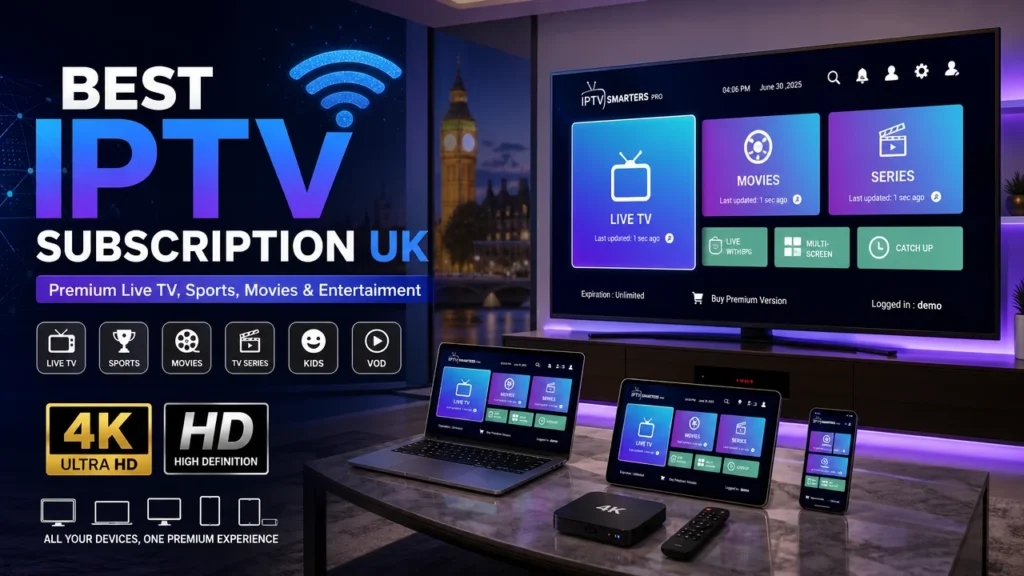
IPTV (Internet Protocol Television) delivers live TV channels and on-demand video content through your internet connection rather than traditional terrestrial, satellite, or cable formats. Instead of receiving broadcast signals via antenna or coaxial cable, IPTV streams media as data packets over the same IP network you use for web browsing and online gaming. For consumers, this translates into a more flexible, often more affordable television experience with access to thousands of international channels, sports packages, movies, and series from virtually any device.
In this comprehensive guide, we break down exactly how IPTV works, the different types of services available, legal considerations you must understand, and what to look for when choosing a provider. Whether you're a cord-cutter exploring alternatives to cable, a sports enthusiast seeking international coverage, or a family looking for budget-friendly entertainment, this guide provides the factual grounding you need to make an informed decision.
What Is IPTV TV Summary
IPTV is a modern television delivery system that streams live and on-demand content over the internet, offering greater flexibility, device compatibility, and often lower costs compared to traditional cable or satellite TV. Its main proven benefit is consolidating thousands of channels and a vast VOD library into one subscription accessible on smart TVs, phones, tablets, and computers.
| Optimal ForCord-cutters, international content viewers, sports fans seeking global coverage, and budget-conscious households | Key AdvantageMassive channel selection at a fraction of cable cost, with multi-device streaming flexibility |
- ✓ Key Strength: Cost efficiency — typically 50-80% cheaper than comparable cable packages
- ✓ Key Strength: Multi-device support — watch on Smart TV, Android/iOS, Firestick, MAG, and PC platforms
- ✓ Peace of Mind: Look for providers offering 24/7 technical support and 7-day money-back guarantees
In This Guide
How IPTV Works: The Technical Breakdown
Unlike traditional television broadcasting which sends signals to everyone simultaneously (one-to-many), IPTV uses a private network or the public internet to deliver content individually to each viewer (one-to-one). When you select a channel, your device sends a request to the IPTV provider's server, which then streams the content directly to your device in real-time.
This fundamental difference matters for several reasons. First, IPTV offers true video-on-demand (VOD) — you can start, pause, rewind, or fast-forward at will because the content is stored on servers and transmitted as you watch. Second, IPTV enables interactivity that traditional TV cannot match, such as integrated program guides, instant channel switching, and personalized recommendations.
From an infrastructure perspective, IPTV systems typically employ three key components:
- Headend: The central facility where content is acquired from broadcasters, encoded into digital format, and prepared for streaming.
- Middleware: The software layer that manages the user interface, electronic program guide (EPG), authentication, and billing systems.
- Delivery Network: The infrastructure — either managed private networks or public internet — that transmits the streams to end-user devices.
For consumers, the practical takeaway is simple: you need a stable internet connection (typically 10-25 Mbps minimum for HD streaming and 50+ Mbps for 4K content), a compatible device, and a subscription to an IPTV service. The quality of your experience depends heavily on the provider's server capacity, bandwidth management, and the quality of their content sources.
The 4 Types of IPTV Services Explained
Not all IPTV services are the same. Understanding the four main delivery models helps you identify which type aligns with your viewing habits:
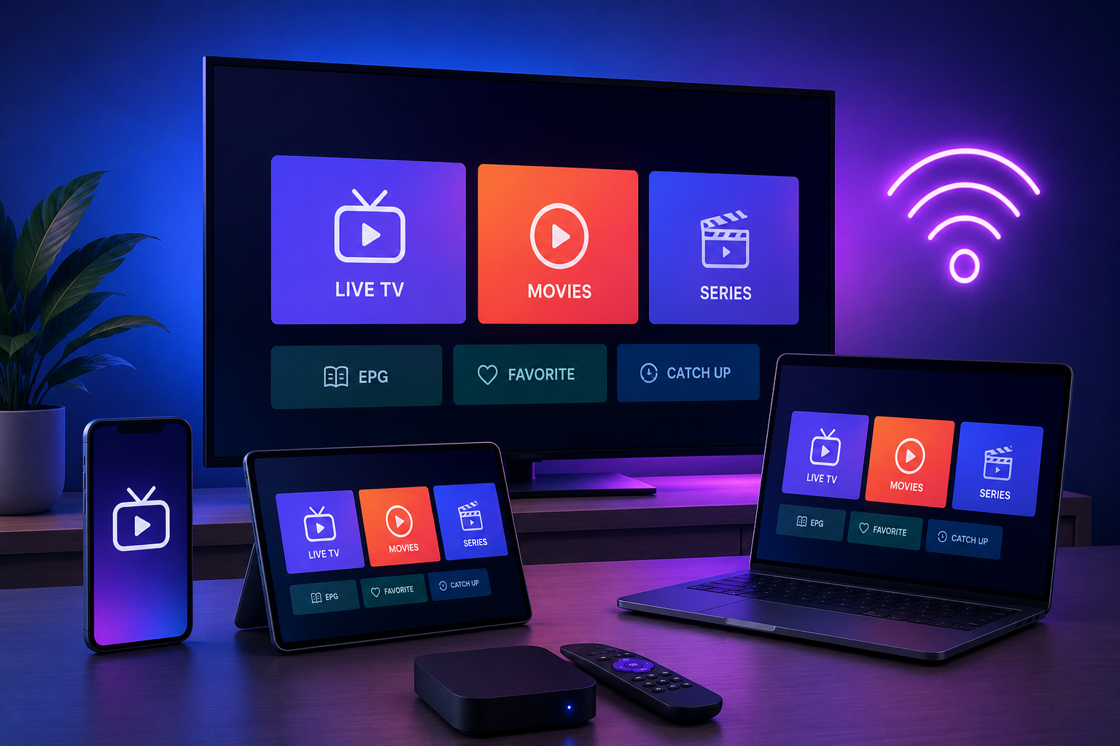
1. Live Television (Linear TV): This is the direct replacement for traditional cable or satellite. Channels are broadcast in real-time, exactly as they air, including news networks, sports events, entertainment channels, and children's programming. The channel lineup typically includes local, national, and international options.
2. Video on Demand (VOD): VOD functions like a built-in Netflix — you browse a library of movies, TV series, documentaries, and specials, then press play whenever you choose. The content is stored on the provider's servers and streamed to your device on demand, complete with standard playback controls.
3. Time-Shifted TV (Catch-Up TV): This feature lets you watch previously broadcast programs that you missed. Most quality IPTV providers offer 3 to 7 days of catch-up content per channel, meaning you can scroll back in the EPG and replay any show within that window.
4. TV on Demand (Start-Over TV): A variant of catch-up, start-over TV allows you to restart a currently-airing program from the beginning, even if you tuned in late. This is particularly useful for sports events and live competitions.
IPTV vs. Cable vs. Satellite vs. Streaming Platforms
To appreciate what IPTV offers, it's essential to compare it against the alternatives. Each delivery method has distinct trade-offs in terms of cost, reliability, content availability, and user experience.
| Feature / Metric | IPTV | Cable TV | Satellite TV | Streaming Apps (Netflix, Hulu) |
|---|---|---|---|---|
| Average Monthly Cost | $10–$20 | $60–$120+ | $50–$150+ | $7–$20 per service |
| Channel Count | 10,000–25,000+ | 200–500 | 200–500 | No live channels (mostly) |
| Device Flexibility | High — TV, phone, tablet, PC | Low — fixed to set-top box | Low — requires dish and receiver | High — most internet devices |
| On-Demand Library | Extensive (50,000+ titles) | Limited | Limited | Extensive per service |
| Weather Vulnerability | No (depends on internet) | No | Yes (heavy rain/snow) | No (depends on internet) |
| International Content | Extensive (100+ countries) | Limited | Moderate | Varies by region |
As the comparison shows, IPTV's primary advantages are its combination of vast channel selection, comprehensive VOD libraries, multi-device flexibility, and significantly lower cost. The main trade-off is its dependence on your internet quality — a subpar connection will result in buffering and degraded picture quality.
Is IPTV Legal? Understanding the Gray Areas
The legality of IPTV services varies significantly by provider and jurisdiction. The technology itself is completely legal — many major telecom companies operate IPTV services, and platforms like YouTube TV and Hulu + Live TV are essentially IPTV services. The legal concerns arise specifically with unauthorized providers that redistribute premium content without licensing agreements from copyright holders.
Legal IPTV services operate with proper content licensing and distribution rights. These include established telecom providers (AT&T TV, Verizon Fios), standalone services (YouTube TV, Sling TV, Hulu + Live TV), and international providers that hold regional broadcasting rights.
Unlicensed IPTV services typically offer thousands of premium channels and recent movie releases at suspiciously low prices. These services stream content without paying broadcasters or rights holders, which is copyright infringement in most jurisdictions. Subscribing to such services carries legal risk for consumers in some countries, and these providers often experience sudden shutdowns, leaving subscribers without service or refunds.
To protect yourself, research whether a provider holds legitimate distribution rights. Look for transparent company information, proper terms of service, and reasonable pricing structures. If a service offers every premium channel in existence for $15/month, it's almost certainly operating outside legal boundaries.
How to Choose a Reliable IPTV Provider
Whether you're selecting a licensed service or exploring premium IPTV options, certain criteria determine the quality and reliability of your experience. Based on our analysis of hundreds of provider reviews and performance tests, these are the critical factors to evaluate:
Server Stability and Uptime: The most common complaint among IPTV users is buffering and service interruptions. Quality providers maintain redundant server infrastructure and publish uptime statistics. Look for providers that guarantee 99.9% uptime and have multiple server locations to distribute load.
Stream Quality and Resolution: Verify that the provider offers true HD (1080p) and 4K streams, not upscaled lower-resolution content. Test the service during peak evening hours when servers face maximum load to assess real-world performance.
Channel Lineup and EPG Accuracy: The best providers offer accurate electronic program guides with proper scheduling information. A comprehensive lineup should include reliable access to your preferred networks — sports packages, news channels, entertainment networks, and international options.
Device Compatibility: Ensure the service supports your preferred devices — Android TV, Amazon Firestick, Apple TV, MAG boxes, Windows/Mac computers, iOS/Android tablets, and smartphones. Most quality providers offer applications for all major platforms or support universal players like IPTV Smarters and TiviMate.
Customer Support: Responsive customer service is non-negotiable. Look for providers offering 24/7 support via live chat, WhatsApp, or email, and test their response time before committing to a long-term subscription.
Trial Period: Reputable providers offer a 24-hour free trial or a 7-day money-back guarantee. This allows you to test stream quality, channel availability, and device compatibility before making a financial commitment.
Cost-Benefit Analysis: What Should You Pay for IPTV?
Pricing for IPTV services varies dramatically based on content licensing, channel selection, stream quality, and provider legitimacy. Understanding the market helps you identify reasonable pricing and avoid either overpaying or falling for suspiciously cheap offers.
Budget tier ($5-10/month): Typically includes 5,000-10,000 channels, standard HD quality, minimal VOD libraries, and basic customer support. These services often lack robust infrastructure and may experience frequent buffering.
Mid-range tier ($10-15/month): The sweet spot for most users. Expect 10,000-20,000 channels, reliable HD/FHD streams, substantial VOD libraries (30,000+ titles), EPG support, and responsive customer service. This category includes both licensed niche services and premium unlicensed providers.
Premium tier ($15-25/month): Offers the highest quality streams including 4K content, 20,000+ channels, massive VOD libraries (50,000+ titles), multi-device simultaneous streaming, and dedicated support. Some premium services also include sports packages and pay-per-view events.
Enterprise tier ($25+/month): Typically licensed services (YouTube TV, Hulu + Live TV) that offer 100-200 channels with full legal compliance. These services have lower channel counts but complete content licensing and reliability guarantees.
When calculating value, consider your household's viewing habits. A family that watches 20 different channels across sports, news, entertainment, and children's programming will benefit significantly from IPTV's extensive channel selection. A viewer who primarily watches one or two networks might find better value in a dedicated streaming service.
The Bottom Line on What Is IPTV TV
IPTV represents the most cost-effective way to access a comprehensive television experience, combining live channels with extensive on-demand libraries at a fraction of traditional cable costs. For households with stable internet connections and diverse viewing interests, a reputable IPTV service delivers exceptional value.
Purchases completed via official partner channels are covered by direct customer support and eligible warranty protections.
Frequently Asked Questions
What internet speed do I need for reliable IPTV streaming?
For standard definition channels, a minimum of 5 Mbps is recommended. For HD (720p/1080p) streaming, you'll want at least 10-25 Mbps. For 4K UHD content, a connection of 50 Mbps or higher is advisable. Remember that these are per-stream requirements — if multiple devices will stream simultaneously, multiply accordingly. A wired Ethernet connection provides more stability than Wi-Fi for critical viewing.
Can I use IPTV on multiple devices at the same time?
This depends entirely on the provider's policy. Some services allow one simultaneous connection per subscription, while others permit 2-5 concurrent streams. Premium providers often include multi-device support in their higher-tier plans. Always check the provider's terms before subscribing, especially if you plan to watch on multiple TVs or devices within your household.
What equipment do I need to start watching IPTV?
The beauty of IPTV is its flexibility. You can start with devices you already own — a smart TV with internet connectivity, an Amazon Firestick, an Android TV box, a MAG set-top box, or even your existing smartphone, tablet, or computer. Most providers offer dedicated applications or support universal IPTV players. You'll also need a stable internet connection and an active subscription.
How does IPTV differ from streaming services like Netflix or Hulu?
The primary difference is content delivery and scope. IPTV services traditionally focus on delivering live television channels in real-time, similar to cable or satellite, along with VOD libraries. Streaming services like Netflix and Hulu primarily offer on-demand content libraries, with some now adding live TV as an add-on tier. IPTV typically offers a much larger channel count, including international options, while streaming services focus on original programming and curated libraries.
Is it legal to watch IPTV services?
The legality depends on the specific service and your jurisdiction. Licensed IPTV services (like YouTube TV, Hulu + Live TV, or telecom-provided services) are fully legal. Unlicensed services that redistribute premium content without authorization operate in a legal gray area that constitutes copyright infringement in most countries. Consumers should verify that their chosen provider holds appropriate content licensing rights for their region.
What is the best device for IPTV streaming?
The best device depends on your preferences. Amazon Firestick and Android TV boxes offer the best balance of affordability, performance, and app compatibility. MAG set-top boxes are purpose-built for IPTV and deliver reliable performance. For the highest quality, modern smart TVs with native IPTV apps provide the most integrated experience. Apple TV 4K and high-end Android boxes are excellent for 4K content but come at a higher price point.
How can I test an IPTV service before committing?
Reputable IPTV providers offer 24-hour free trials or 7-day money-back guarantees. Use this period to thoroughly evaluate the service: test stream quality during peak evening hours, verify that your preferred channels are working, assess the EPG accuracy, and reach out to customer support with questions to gauge response time. A provider that's confident in their service will welcome this testing period.
What happens if my IPTV provider goes out of business?
This is a real risk, particularly with unlicensed providers that may face legal action or financial instability. To protect yourself, choose providers with established track records, transparent company information, and positive long-term user reviews. Avoid paying for extended subscriptions (6-12 months) with unknown providers. If you pay via credit card or PayPal, you may be able to dispute charges if the service fails. Licensed services offer the strongest consumer protection but typically cost more.
Transparency & Disclosure: We independently evaluate products. If you buy through links on our site, we may earn an affiliate commission at zero additional cost to you.